
Pick a finishable deliverable
A short opening is useful when the task has an obvious ending. “Do some prospecting” can expand indefinitely. “Prepare the answer for one scheduled callback” lets you know when you are done.
The time examples below are planning illustrations, not productivity promises. Use the time you actually have, including the margin needed to return to your next commitment. Avoid starting a conversation you cannot responsibly finish just because the schedule contains a gap.
Match the task to the available time
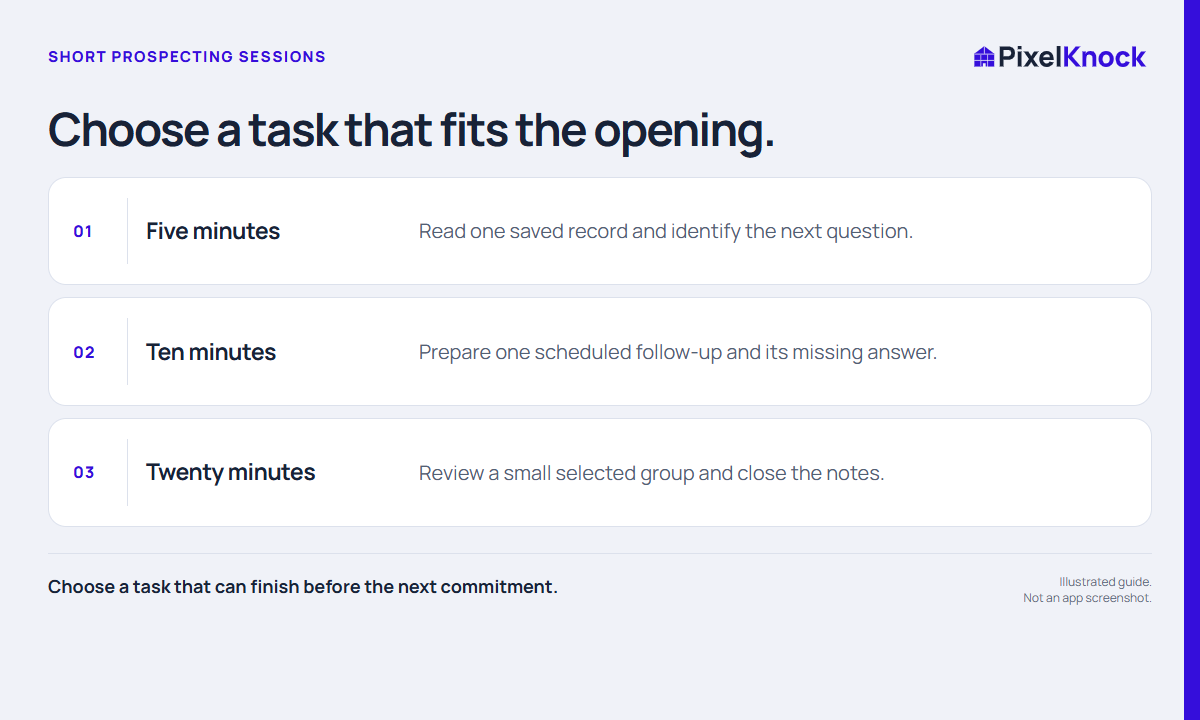
| Available opening | A bounded task | Finished means |
|---|---|---|
| About five minutes | Read one saved home | The next question is explicit |
| About ten minutes | Prepare a scheduled follow-up | The promised information is ready or its owner is identified |
| About twenty minutes | Review a small selected group | Each reviewed record has a clear next decision |
Choose one row rather than trying to complete all three. If a record reveals a larger issue, write the issue down and choose a later time to resolve it. The useful result is a complete small piece of work, not a growing collection of half-open tasks.

Start from the work already saved
Open Saved Homes or the appropriate Follow-ups view. Select a home relevant to the next commitment and read the latest note. Existing context can tell you more about what needs attention than another search for new properties.
A fictional example: a rep has a short opening before a meeting. They review the afternoon callback record, discover that a service-availability answer is still missing, and identify who must confirm it. That is a useful preparation result even though no new contact was researched or called.
If the task truly needs new information, review the explicit reveal action and credit quote. Do not let the limited time pressure you into repeated requests before you know whether the information will help.
Leave a clean restart point
Before stopping, save what you learned and what remains open. A useful restart note says “Coverage confirmed; appointment availability still needs operations review” rather than “Continue later.” Keep an actual agreed follow-up time in the schedule, and an internal preparation question in the note.
If interrupted, leave the record at a clear state rather than marking work complete to make the list look tidy. Review what you finished at the end of the day. The habit to build is continuity between sessions, not a quota of actions in every spare minute.