
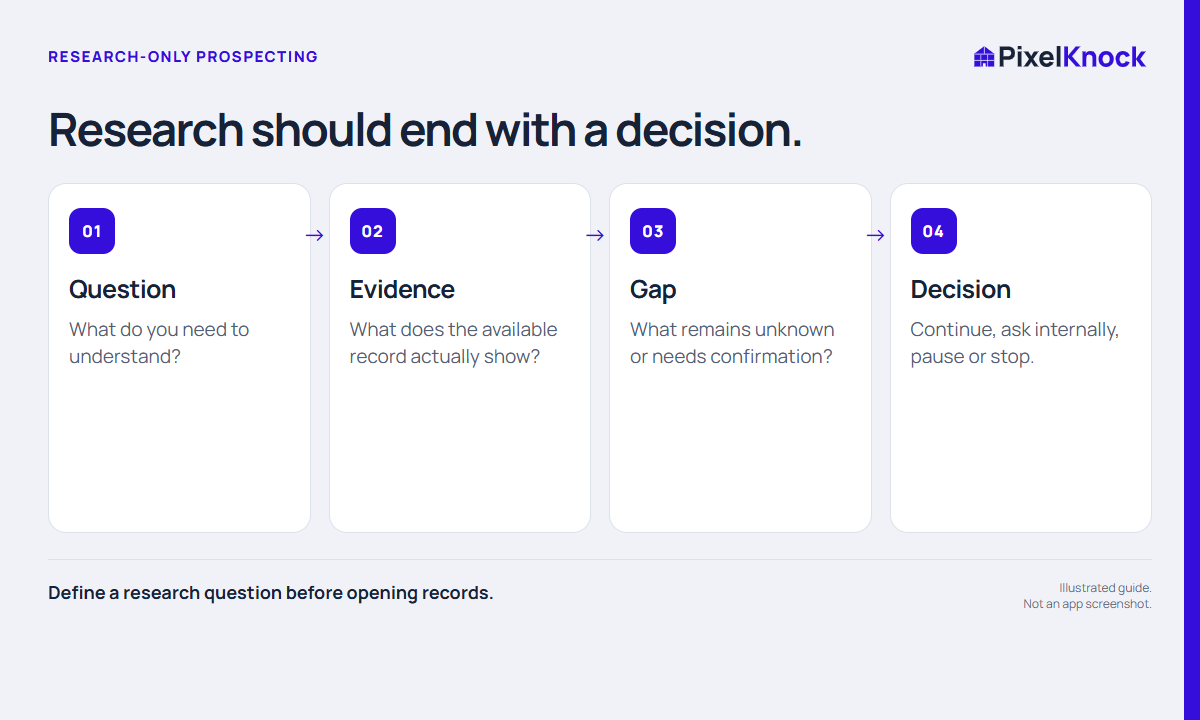
Define a question that research can answer
A research-only session can help you understand an area, review saved property context or prepare questions for a later conversation. It should not be a substitute for asking the homeowner about needs that data cannot establish.
Write a specific question: “Which saved records need a service-coverage check?” is actionable. “Find people who want our service” asks the data to infer intent it does not show. Choose a deliverable you can inspect at the end of the session.
Begin with available context
Review the selected neighborhood and open saved records relevant to the question. In PixelKnock, selecting a home and reviewing saved details are different from explicitly revealing contact information. Read existing notes before deciding whether more data is necessary.
If a new reveal is useful, inspect the quote and the returned result. Neither opening a record nor revealing details sends a call, text or email. The session can remain research-only throughout; your phone or dialer is a separate part of the workflow.

Write evidence and uncertainty separately
Use this copyable structure in a saved research note:
Question: [the business decision]. Available: [facts shown or confirmed]. Unresolved: [what the record does not establish]. Next decision: [the smallest useful next step].
For a fictional example: “Question: is this edge-of-area home serviceable? Available: the selected property location. Unresolved: current coverage policy for this street. Next decision: confirm with operations before proposing a visit.”
| Keep | Avoid |
|---|---|
| The question you set out to answer | A pile of unrelated fields |
| Facts and their source | Rewriting an association as certainty |
| Missing information | Treating a blank field as a negative answer |
| A next decision | Assuming research requires immediate outreach |
On a newly selected unsaved home, follow the actual save/reveal workflow rather than assuming draft selections already hold persistent notes.
End when the decision is clear enough
More research is not always more useful. If the home is outside confirmed coverage, another contact detail may not change the decision. If a missing answer belongs to your operations team, ask the appropriate person rather than continuing to buy unrelated information.
Close the session with the findings, unresolved questions and any actual follow-up time. A pause is a legitimate result when the evidence does not support the next action. PixelKnock keeps the property context available so a later session can begin from that decision instead of repeating the same uncertainty.