

Choose a note that someone must use next
Pick a record with an active question, requested callback or upcoming visit. Read the note without asking its author to explain it first. The point is to discover what the saved record actually communicates, not what the team can reconstruct from memory.
In PixelKnock, open the saved home and read its Activity alongside the current outcome and follow-up. A note may make sense only when read with a later correction. Review the latest relevant sequence rather than judging one sentence in isolation.

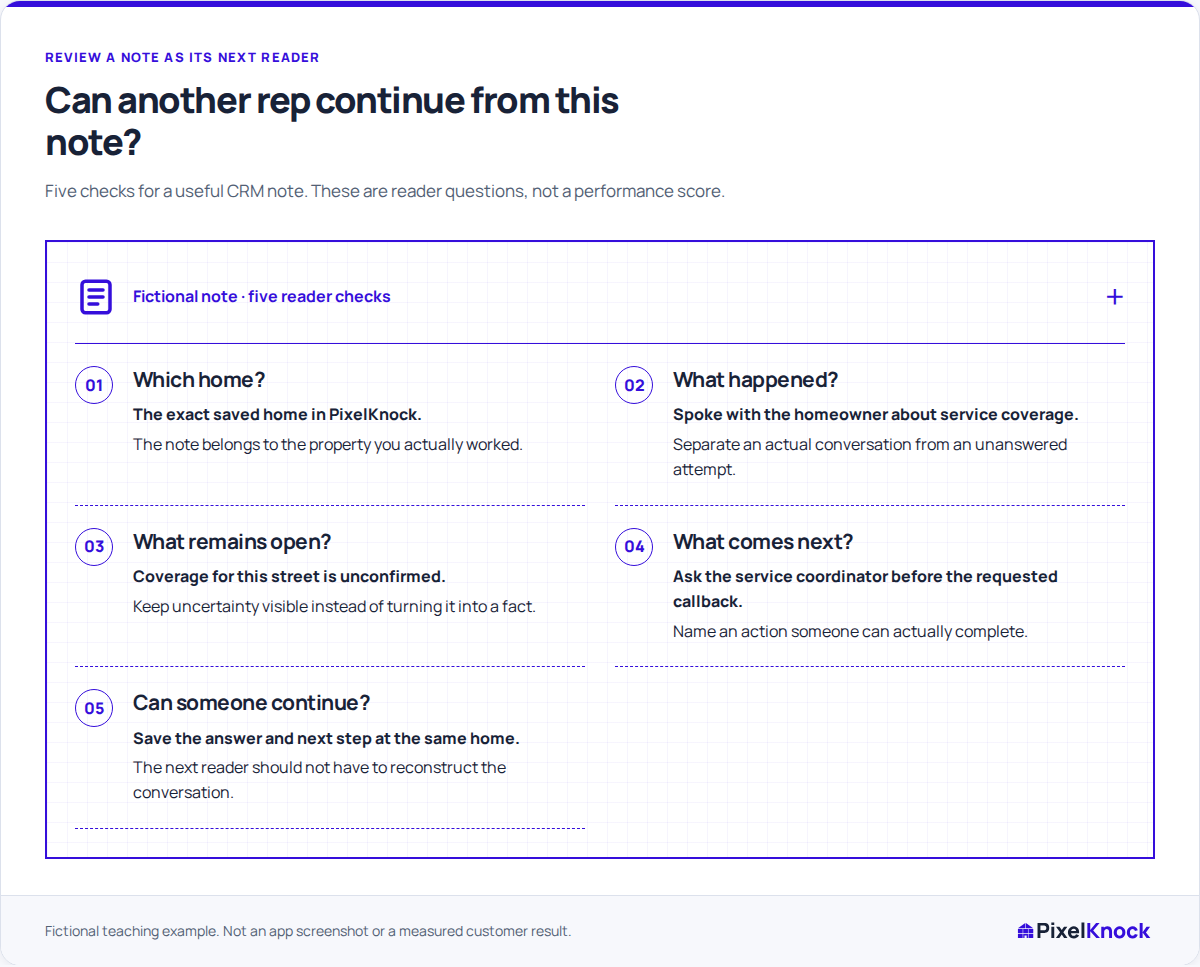
Apply five completeness questions
| Reader question | What a useful answer contains |
|---|---|
| Which home? | The intended property and workspace, with no ambiguity about the record |
| What happened? | The actual conversation, attempt, visit or research step and its subject |
| What remains open? | The missing answer and any agreement that still needs clarification |
| What comes next? | A bounded action that reflects the real commitment, or the absence of one |
| Can someone continue? | Enough context for the next reader, including who accepted the action through your team process |
Use “clear,” “needs clarification” or “not applicable” for each question. Do not turn the rubric into an automatic quality score. A short no-answer note does not need a visit agenda, and an unresolved research question should not be padded with a fictional agreement to satisfy the checklist.
Repair a fictional weak note
Consider: “Good call. Follow up about the visit.” A reader cannot tell whether a visit was agreed, what the homeowner asked or what must happen before another conversation.
After checking the actual facts, a clearer fictional version could be: “Homeowner asked whether an assessment includes the detached garage. No visit agreed. I will confirm the scope internally before discussing possible times.” That correction supplies a subject, uncertainty and next task without upgrading interest into an appointment.
If an actual callback time was agreed, save that date and time in PixelKnock as well. Mentioning a time in prose does not itself create a saved follow-up. If no time was agreed, keep that uncertainty visible.
Make the smallest useful correction
Ask the author only for the missing fact that changes the next decision. “Was a visit agreed?” is more precise than “Can you improve this note?” Keep the correction attached to the home so a teammate who never attended the review can understand it.
An authorized teammate can add a clarifying note and adjust an inaccurate outcome where appropriate. Preserve why the correction was needed instead of making the record look as though the uncertainty never existed. If you have read-only access, hand the question to someone who can update the record.
Finish when the next reader can continue
Read the revised context once more. Can you identify the open question and the supported next action? If so, the review has done its job. Leave remaining unknowns visible rather than converting them into confident language.
Use recurring gaps to improve the team's note examples. The rubric is a qualitative writing aid, not measured rep performance, customer sentiment or a prediction of sales.