
Agree on what a note must accomplish
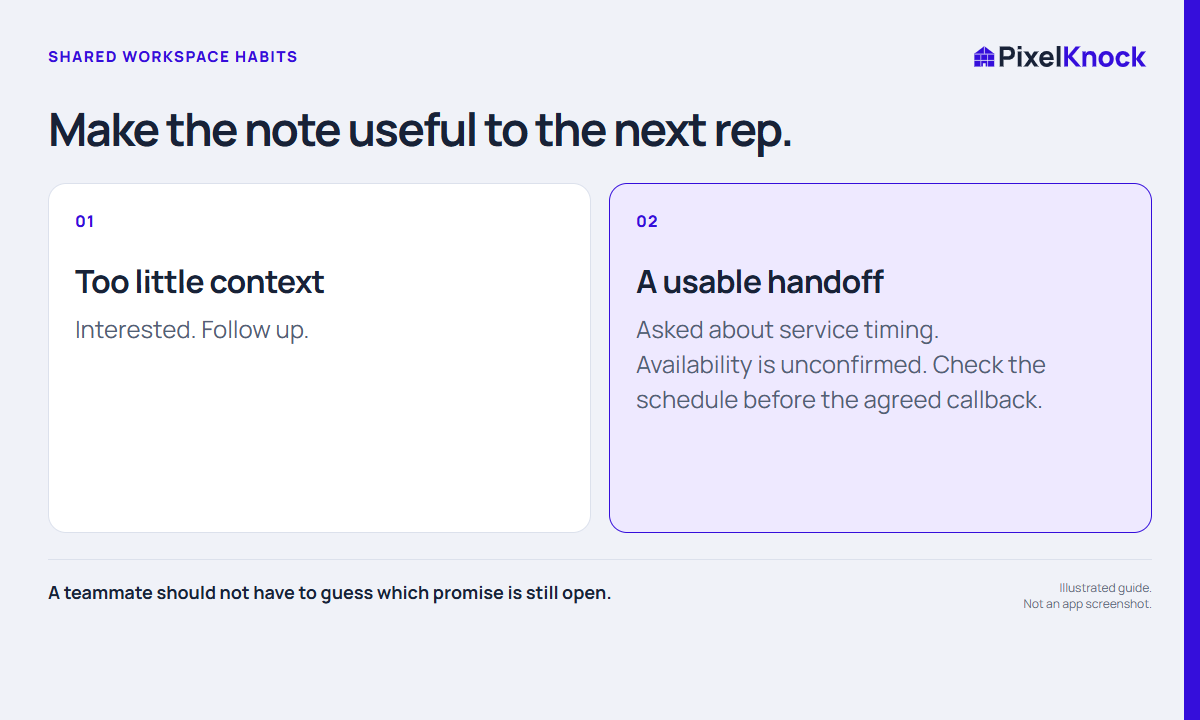
A team note should help someone understand the last conversation and choose the next action. It does not need to record every sentence. The useful standard is the amount of context another person needs, not a fixed paragraph length.
Ask each rep to bring one fictional or appropriately anonymized example to a short review. Compare what is easy to understand and what requires a follow-up question. Use those gaps to define the standard instead of prescribing a complicated form before the team has tried it.
Use four plain-language prompts
- What happened? State the attempt or conversation outcome.
- What was said? Keep the relevant question or request factual.
- What is unresolved? Name an answer, identity or service detail that is still unknown.
- What comes next? Record the intended action and any timing that was actually agreed.
A missed call may need only one sentence. A conversation with an open service question may need all four prompts. Leave out details that do not help with the business task.
Compare three fictional entries
| Entry | Why it is useful |
|---|---|
| “No answer. No conversation took place.” | Records an attempt without suggesting interest. |
| “Asked about installation timing. Availability not confirmed. Check schedule before the requested callback.” | Preserves the question and the unfinished commitment. |
| “Said they are not interested. No follow-up was agreed.” | Gives the next reader a clear account of the response. |
These are invented examples, not customer results. Keep the same distinction in your real notes: a homeowner’s statement and your interpretation are different kinds of information.
Make the shared record readable
PixelKnock keeps notes and manual outcomes with the saved home in a workspace. Teammates with access can review that context, and roles control who can manage, edit or view records. Use the Activity tab to see the saved history before choosing another action.
A shared record does not assign a rep, reserve a territory or prevent two people from planning the same outreach. Confirm responsibility through your own team process. A Call back outcome requires a saved follow-up time; any reminder belongs in the calendar you use.

Review the standard with real working questions
During a team review, ask a teammate to read a note and explain the next step. If they cannot tell what was promised or what is still uncertain, improve the wording. Avoid judging note quality by length or by how enthusiastic it sounds.
Keep the standard brief enough to use after an ordinary attempt. Revisit it when your service, team roles or working process changes. A consistent factual record gives people a better place to start; it is not a substitute for their judgment about the next conversation.