

Select a small set of decisions
Choose records with a specific unresolved issue: a service question blocking a callback, an appointment whose preparation changed or a handoff that nobody has accepted. A large list of saved homes is not automatically a useful meeting agenda.
Before the meeting, ask each participant to read the relevant PixelKnock home notes and saved follow-ups. That makes the discussion about the open decision rather than an oral replay of the full history. Use an appropriate workspace role for each participant.

Use a short agenda and a decision log
This twenty-minute agenda is illustrative, not a productivity benchmark:
| Time | Meeting task | Result to capture |
|---|---|---|
| First 3 minutes | Confirm the three decisions being discussed | A clear question for each home |
| Next 12 minutes | Read the current evidence and resolve what is possible | Decision, missing fact or accepted check |
| Final 5 minutes | Confirm who acts and what changes in the record | A short decision log with a verification step |
A useful log has four fields: home, decision, accepted next action and what will show the action is finished. Add an agreed date where it belongs, but do not manufacture deadlines or homeowner commitments just to fill every cell.
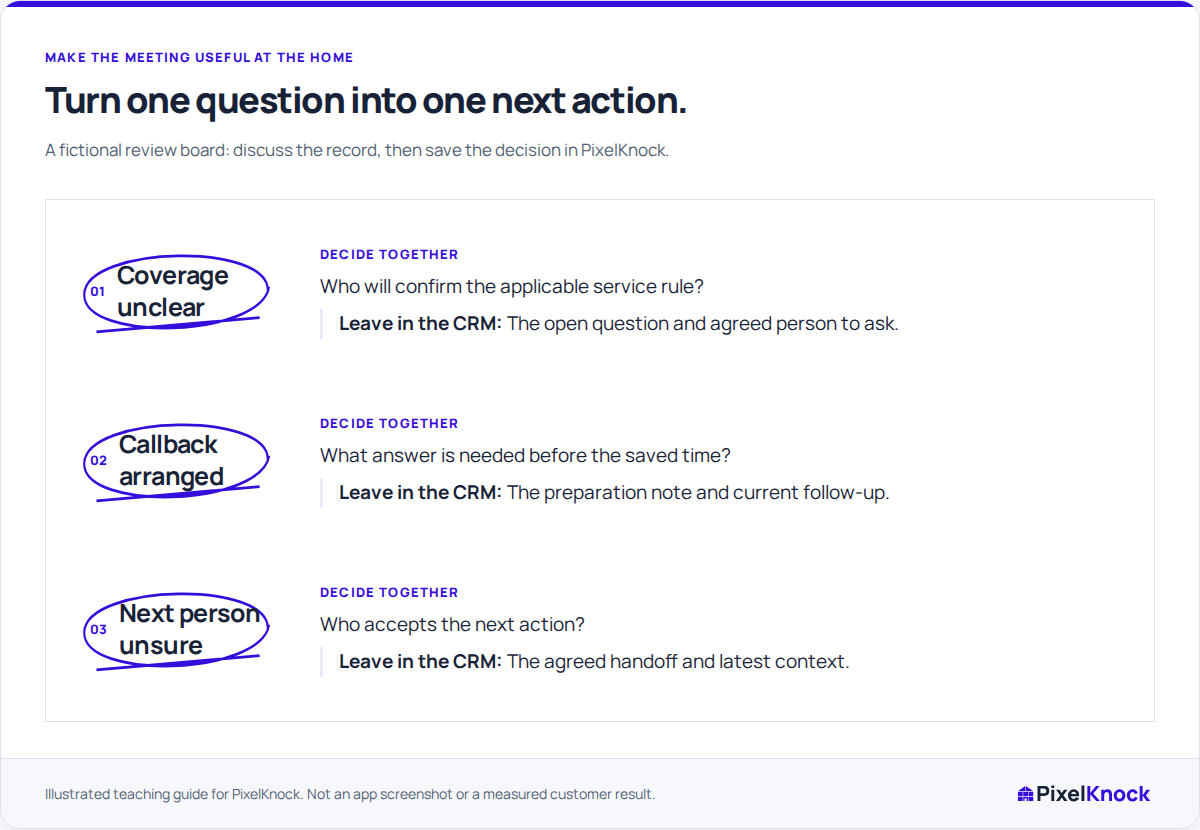
Work through three fictional records
Home A: an unanswered scope question. The note says the homeowner wants to know whether a detached garage is included. The team cannot promise coverage yet. Decision: one teammate accepts the internal scope check; the saved callback context continues to show the question as open until that answer is recorded.
Home B: preparation already completed. The saved task was to confirm a document requirement. A later note contains the answer. Decision: an authorized teammate checks the evidence and marks that preparation task done, without implying the homeowner visit has occurred.
Home C: an unaccepted handoff. The record says “someone should follow up,” but nobody agreed to act. Decision: settle responsibility directly. If no one accepts, record the unresolved handoff rather than pretending shared access created an owner.
Put the result where the next reader will find it
Save the useful decision at the home in PixelKnock. A private meeting note that never returns to the CRM leaves everyone else with the old uncertainty. Keep the relevant result concise: what was decided, what remains open and who accepted the next action through your team process.
Save an agreed callback or appointment time as a follow-up as well as describing it in prose. Maintain external alerts separately. The meeting itself does not create automatic assignments or notifications.
Close with verification, not a larger agenda
Read the action log aloud and check that the named people accepted their tasks. Choose how the team will verify each result, such as finding the confirmed scope answer in Activity. At the next review, inspect that evidence before reopening the same debate.
The meeting is complete when each selected home has a clear decision or an explicit unresolved question. A useful outcome can be “we still need this fact”; it does not need to be a promised sale or a performance score.