
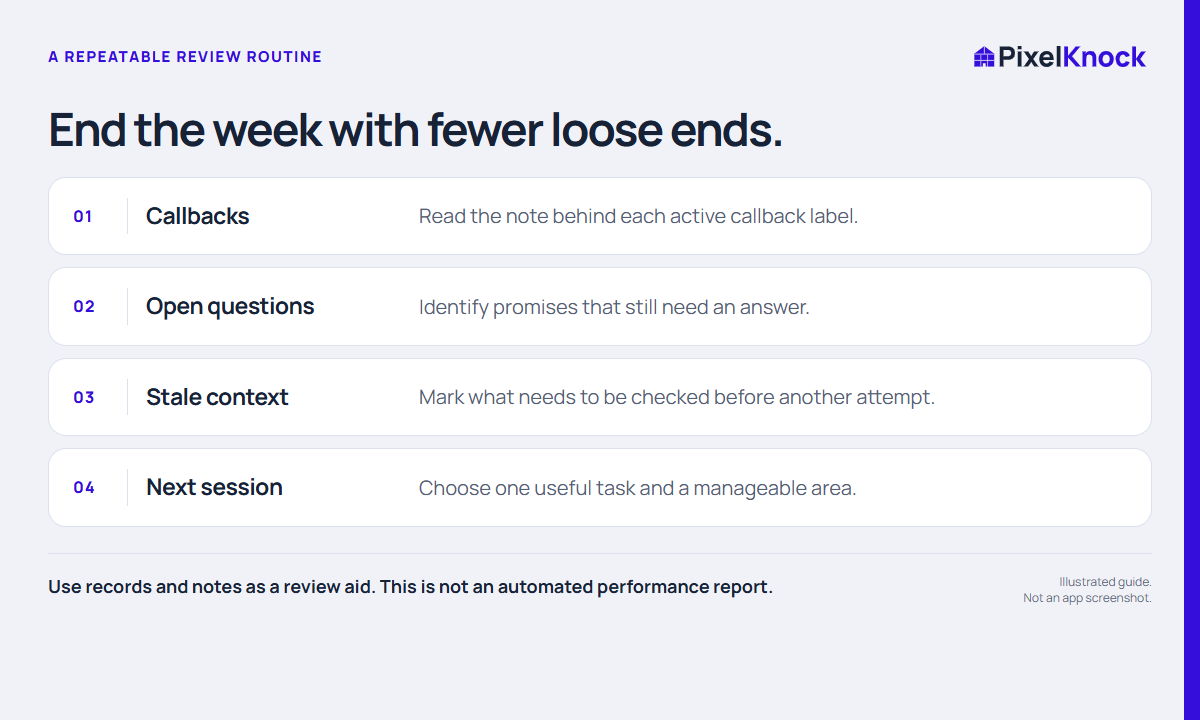
Give the review a decision to produce
A weekly review should leave you knowing what needs attention and why. It does not need to become a presentation about the number of records saved.
Choose a bounded set of active homes and a short review window. A solo rep can use the same process as a small team: find unresolved commitments, check the context, and make the next responsibility clear. PixelKnock supplies saved records; this is a manual review routine, not an automatic performance report.
Start with commitments already made
Look first for requested callbacks, appointment arrangements, and questions you promised to answer. Check the actual scheduling tool or calendar where the arrangement is managed. A note that mentions a time is not evidence that a reminder was created.
For each commitment, identify the question still open and the person handling it. If the team has not decided who will act, make that decision explicitly in your normal operating process rather than assuming workspace access assigns responsibility.
Review saved homes with the notes open
Use the saved-home view and available outcome filters to focus the review. Then open individual records. A callback label is useful for finding work; the note explains the requested topic and what has changed.
| Review prompt | Useful decision |
|---|---|
| What did we promise? | Confirm the next arrangement and responsible person |
| What remains uncertain? | Name the fact that needs checking before another attempt |
| What has become stale? | Update the context or explain why the work is paused |
| Can another teammate continue? | Add missing handoff information |
Do not change an outcome just to make the list look current. Record the event or decision that justifies the change.

Notice process gaps without inventing metrics
Repeated vague notes may tell you that the team needs a clearer note standard. Several unresolved service-boundary questions may mean the boundary needs an internal decision. These are observations from the records you reviewed, not a statistical claim about every rep or neighborhood.
Agree on one practical adjustment for the next week: include the question asked in callback notes, or check service coverage before selecting more homes near the edge of an area. Keep the adjustment specific enough to inspect later.
End with a short action record
Write down the next decisions, who is handling them, and where time-sensitive actions are scheduled. Put relevant property context back on the home so it survives beyond the meeting.
At the next review, begin with those decisions. Did the question get answered? Did the handoff contain enough context? That loop makes the review useful without claiming that a dashboard or a larger saved list automatically produces sales.