

Choose tomorrow's first decision
Start with a small set of homes that already have a reason to matter. A requested callback, an unanswered scope question or a visit needing preparation is a clearer starting point than a large list of addresses selected without context.
Use Saved Homes or Follow-ups in PixelKnock to find the relevant records, then read their latest Activity. The current note may change the task you remember. Tomorrow's plan should use the newest known arrangement, not a copy of yesterday's intention.

Check what is actually arranged
For a callback or appointment, inspect the saved date and time and the note explaining its purpose. Check the displayed local time zone. If you maintain an external calendar alert, compare that entry separately.
A proposed task is not automatically a homeowner agreement. “Review the coverage answer tomorrow” can be your internal plan. “Call tomorrow at the agreed time about coverage” requires an actual arrangement and a corresponding saved follow-up. Keep the difference explicit.
Write a three-line opening brief
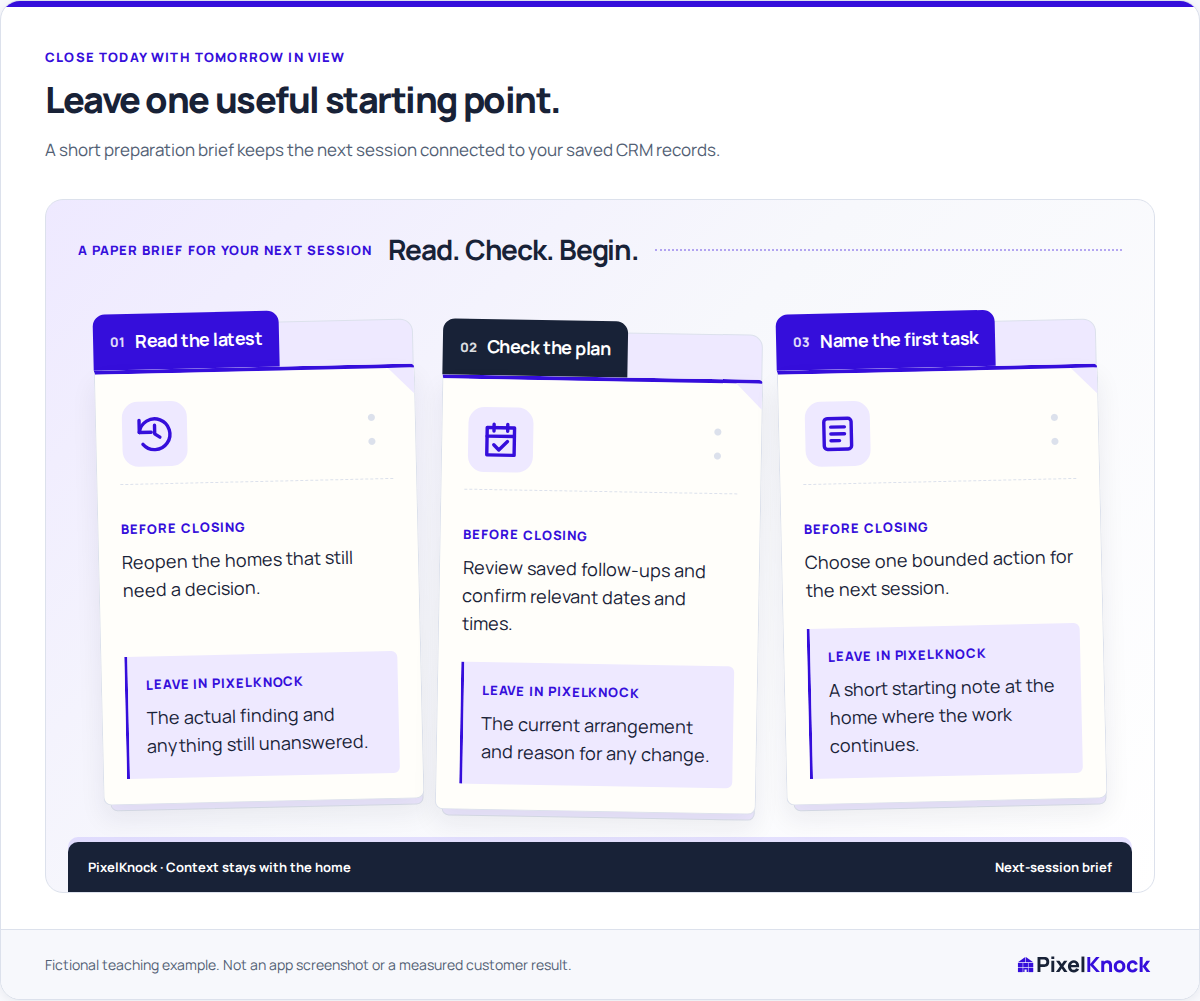
Use this structure beside the relevant home:
| Brief line | Fictional example |
|---|---|
| Latest finding | “The homeowner asked whether the detached garage is included.” |
| Current arrangement | “A callback is saved for the agreed time tomorrow; no visit booked.” |
| First bounded task | “Check the assessment scope internally before preparing the callback.” |
The example works because the opening task has a finish condition. “Do more research” does not. You should be able to tell whether the scope question was answered and what remains unknown if it was not.
Surface the preparation gap
Check whether the information or person needed for that first task will be available. If not, record the dependency rather than moving a homeowner commitment silently. A teammate's internal answer and a homeowner's agreement are separate events.
When work is being handed to another rep, confirm that they accepted it through your team process. Put the useful context in PixelKnock so they can reopen the home; membership in the workspace does not itself assign the task.
Leave a manageable return point
End by reopening the selected home and reading the brief without your original train of thought. Can you find the latest finding, arrangement and first action? Resolve ambiguous phrases such as “tomorrow afternoon” before they become misleading when read on another day.
This is a preparation routine, not an automatic itinerary or a promise about the best contact hour. The next session still depends on the actual arrangement, current information and your organization's operating rules. Keep the starting set small enough that you can inspect it properly when you return.