
Treat the request as a specific task
A callback is easier to prepare when you know why the person asked you to return. “Call later” leaves several questions unanswered: what should be discussed, what needs to be confirmed and whether a particular time was agreed. Start by reading the record rather than filling those gaps from memory.
The goal is to arrive with the relevant context. It is not to assume that a callback request means a purchase decision. Someone may want a service question answered, need more time or simply prefer a different moment for the conversation.
Read the note behind the callback
Open the saved property and review its Activity history. Identify the latest relevant note, especially if several attempts or corrections appear. Separate what the homeowner asked from the rep’s interpretation of the conversation.
In PixelKnock, choosing Call back requires a follow-up date and time. Check the saved schedule, then read the note for the reason behind it. Use your calendar for alerts and your own phone or dialer for the call. See how to save a requested callback for the scheduling steps.

Prepare four pieces of context
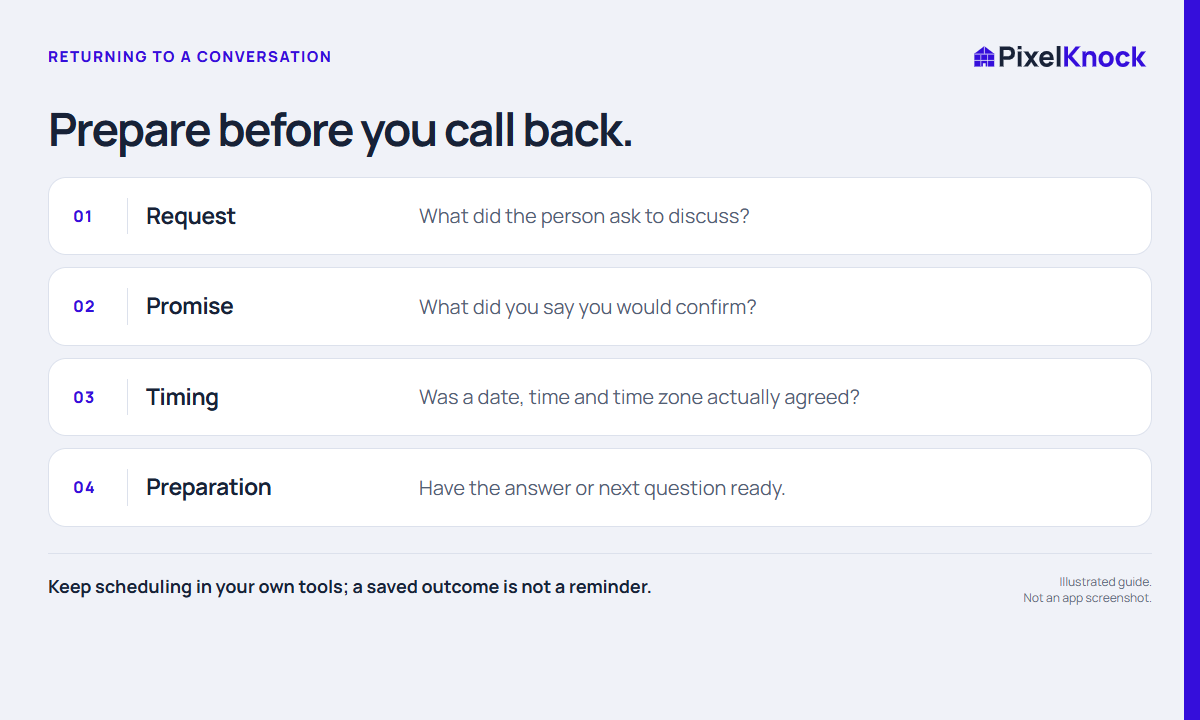
| Prompt | What to check |
|---|---|
| Request | What did the person actually want to discuss? |
| Promise | What did you say you would find out or send through an approved process? |
| Timing | Was a date, time or time zone actually agreed? |
| Preparation | What answer, document or question should you have ready? |
If timing is unclear, record that uncertainty. Do not convert “another afternoon” into a specific appointment. If responsibility moved to another teammate, confirm who will handle the next step before acting.
Work through a fictional example
Suppose the saved note says: “Asked whether the service includes the side of the house. I will confirm the scope before calling back.” The preparation task is to check the service scope with the appropriate person. It is not to repeat the same introduction or claim the request is already covered.
If you cannot confirm the answer, prepare an honest statement about what remains unresolved and the next step you can actually take. Keep an unanswered question visible instead of turning it into a confident promise.
Close the loop in the record
After the attempt, save what happened. If no conversation occurred, record that fact without implying that the question was answered. If the homeowner clarified the request, update the context with the new information and any agreed next action.
The useful test is simple: could you or a teammate read the saved note later and understand what remains to be done? Keep it factual, relevant and short enough to use. A well-prepared callback begins with a clear record and ends by leaving another one.